Containers inherit every weakness baked into their images and pipeline. We review your Docker images, registries and runtime for vulnerable dependencies, leaked secrets and unsafe defaults — for Cyprus DevOps and product teams.
We trace risk from base image and build args through to running workloads, aligned to the CIS Docker Benchmark.
Beyond the checklist, container security assessment is about understanding how a real attacker would abuse image layer & dependency analysis and secrets in build args & layers in your specific environment. We map your real environment, not a generic template, then test every path where trust is granted and every place where controls could be bypassed.
The result is clarity: a prioritised, exploitable-risk view of your container security attack surface that your team can act on immediately, backed by proof rather than a scanner's guesswork.
A convincing security posture is now a commercial requirement across the Cyprus market. A weakness that reaches customer or financial data can trigger a GDPR, NIS2 and ISO 27001 obligation, damage hard-won client trust, and stall deals while security questionnaires go unanswered. Our container security assessment exists to remove that uncertainty before an attacker — or an auditor — finds the gap first.
By proving exactly what is exploitable and what it would cost, we turn a vague worry into a concrete, fundable remediation plan. Cyprus firms use our reports to close real gaps, satisfy CySEC, GDPR and NIS2 expectations, and demonstrate genuine due diligence to clients, partners and insurers — with a free retest to prove the fixes hold.
What we test
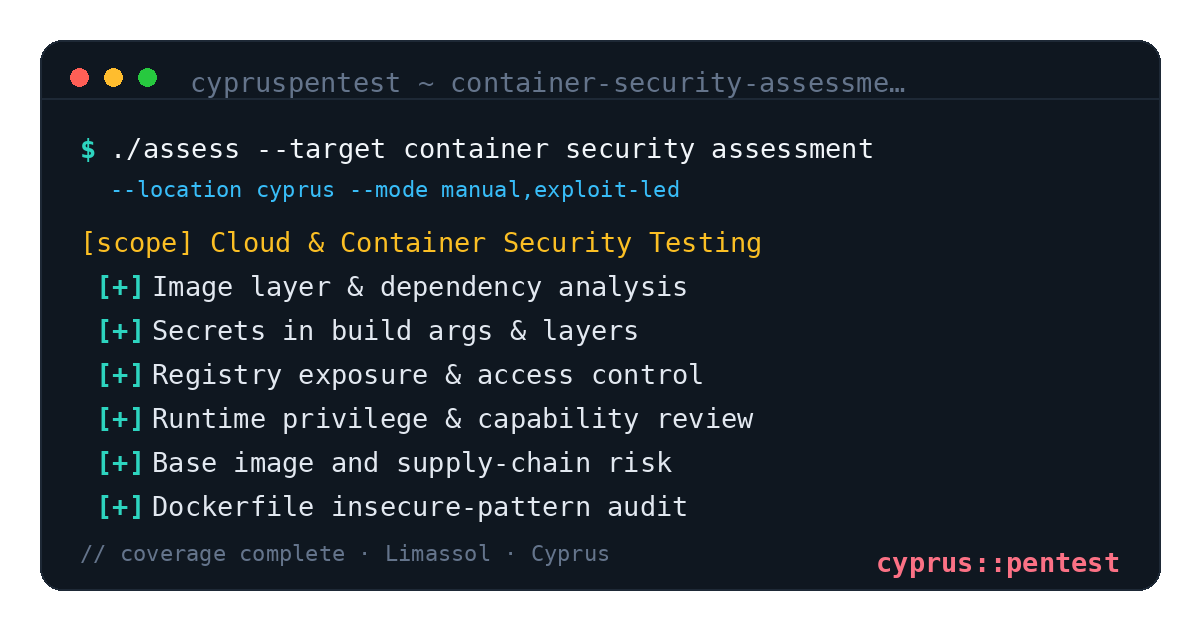
Image layer & dependency analysis
Secrets in build args & layers
Registry exposure & access control
Runtime privilege & capability review
Base image and supply-chain risk
Dockerfile insecure-pattern audit
Common vulnerabilities we uncover
Vulnerable image dependencies
Secrets embedded in image layers and build args
Exposed or unauthenticated registries
Over-privileged runtime and capabilities
Untrusted base images and supply-chain risk
Insecure Dockerfile patterns
How we run your engagement
Kick-off & scoping. A short call to agree goals, in-scope assets and rules of engagement, so your container security assessment is safe, authorised and aimed at your real business risk.
Mapping & discovery. Before touching anything we map the full attack surface in scope, so nothing exploitable slips through.
Hands-on testing. Cyprus-based specialists exploit and chain weaknesses manually — the flaws scanners walk straight past — to show genuine impact.
Reporting. Each issue is verified, CVSS-rated and documented with a step-by-step reproduction and a practical fix your team can apply.
Free retest. Once you have remediated, we re-test at no extra cost to confirm the attack path is truly closed.
Tools & techniques
We tailor each container security assessment to your stack, prioritising image layer & dependency analysis, secrets in build args & layers and registry exposure & access control and any control that stands between an attacker and your data.
We assess your cloud the way an attacker with a foothold would. Automated collectors such as ScoutSuite and Prowler give broad configuration coverage against the CIS Benchmarks, but the real value is in manually chaining identity and access weaknesses — over-permissive IAM roles, exposed metadata endpoints, and privilege-escalation paths — into concrete impact. We test control-plane and workload security, not just a checklist of settings.
Findings are mapped to the specific service and account so your engineers can fix them in Terraform or the console immediately. Where a misconfiguration allows privilege escalation or cross-account access, we prove the path safely and document the blast radius.
When you need this engagement
You are deploying, changing or relying on systems where image layer & dependency analysis would be business-critical
Your platform stores EU customer or payment data subject to GDPR
You need to validate IAM, network and workload configuration against best practice
A client or auditor requires independent assurance of your cloud security
You run containers or Kubernetes and are unsure how an escape or misconfig would play out
What you receive
Image and registry findings
Supply-chain risk assessment
Runtime hardening recommendations
Free retest of rebuilt images
Your deliverables
When your container security assessment wraps up, you receive a clear, audit-ready report plus a walkthrough call with your team. Inside you will find:
A concise executive summary that management and the board can act on
Every technical finding with a reproducible, copy-paste proof of concept
CVSS v3.1 ratings and plain-language business impact for each issue
Practical, prioritised remediation your developers can implement straight away
A free retest and updated finding status once fixes are in place
A signed attestation letter for clients, auditors, GDPR, NIS2 and ISO 27001
By the end of your container security assessment, you will know exactly which weaknesses a real attacker could exploit, what it would cost your business, and the precise order in which to fix them — backed by evidence, not a scanner’s guesswork. Cyprus firms use our findings to close critical gaps, satisfy client and regulator security questionnaires, and demonstrate due diligence for GDPR and NIS2. With a free retest included, you also get documented proof the issues are resolved.
Working with us
Every container security assessment begins with a short, no-obligation scoping call to understand your goals, environment and constraints, followed by a fixed-price proposal. Most work is delivered remotely, and because we are based in Cyprus we work in your timezone with on-site visits across Limassol, Nicosia and island-wide where it helps. We keep you updated throughout and flag any critical finding immediately rather than waiting for the report. Everything is covered by a signed NDA and safe, non-disruptive testing that protects your production systems. You receive your report, a walkthrough and a complimentary retest once fixes land. Engagements are typically booked one to three weeks ahead, and urgent testing can often be arranged — just email hi@cypruspentest.com.
Why Cyprus businesses choose CyprusPentest
Your container security assessment is run by senior offensive-security specialists who test the way genuine attackers do — manually, creatively and focused on proving real impact. What sets us apart:
Based in Cyprus — local, in your timezone, with on-site coverage across Limassol and Nicosia.
Manual, exploit-led testing that chains vulnerabilities the way an attacker would, well beyond automated scanners.
Reproducible proof for every finding, with copy-paste steps your team can independently verify.
Compliance-ready reporting that supports GDPR, NIS2, ISO 27001 and CySEC expectations.
A free retest so you have documented evidence your fixes actually hold.
Fixed-price and responsive, with a named point of contact from scoping through to retest.
Explore related services
Container Security Assessment pairs well with our other Cyprus penetration testing services for fuller coverage. You may also want:
Kubernetes Penetration Testing — Kubernetes penetration testing in Cyprus. Container escape, RBAC and cluster-takeover testing for cloud-native Limassol businesses.
Secure Code Review — Secure code review in Cyprus. Manual source audit plus SAST for Limassol software teams — find…
Cloud Configuration Review — Cloud configuration review in Cyprus across AWS, Azure & GCP. CIS-benchmark posture audit and remediation roadmap…
How much does Container Security Assessment cost?
Every container security assessment in Cyprus is scoped and priced individually, so you pay only for the coverage you need — with no hidden extras. After a short, no-obligation scoping call we send a fixed-price quote, usually within one business day, with clear deliverables, a firm timeline and a complimentary retest included. The price depends on the size and complexity of your environment, so you always know the cost up front before any work begins.