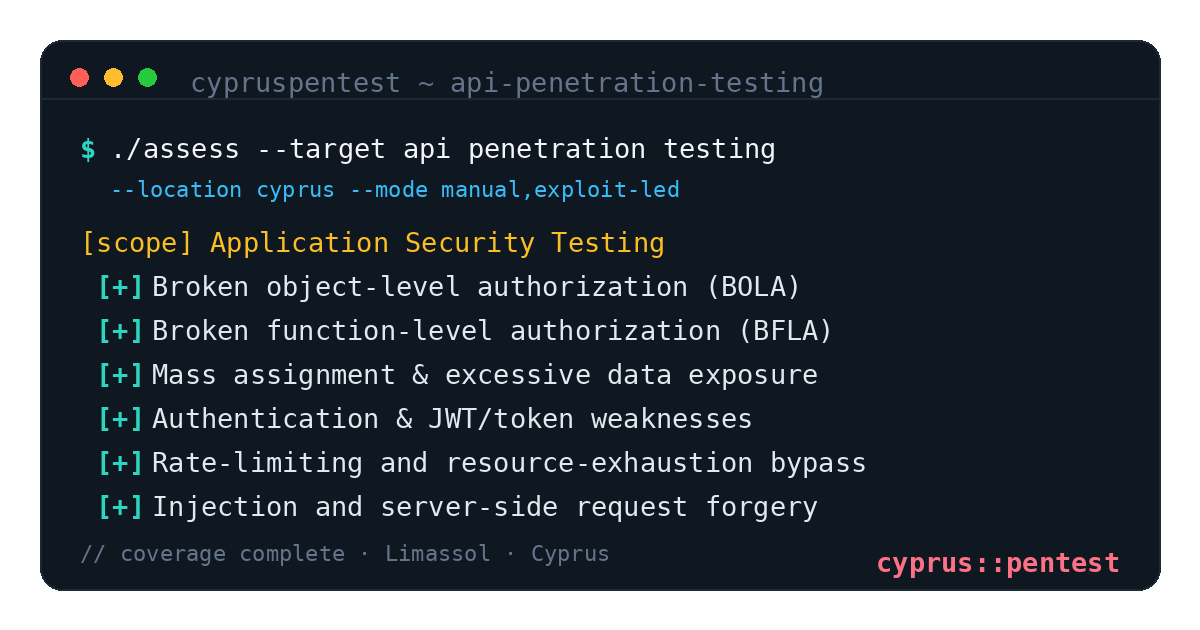
APIs power the fintech, forex and SaaS platforms that Cyprus is known for — and they expose your business logic straight to clients and partners. We map every endpoint and attack authorization, tokens and rate limits against the OWASP API Security Top 10.
Working from your OpenAPI spec or captured traffic, we surface the BOLA and mass-assignment flaws that lead to real data breaches, not just scanner noise.
What separates our api penetration testing is depth: we don't stop at the first finding, we chain weaknesses until we can prove genuine business impact. We map your real environment, not a generic template, then test every path where trust is granted and every place where controls could be bypassed.
The result is clarity: a prioritised, exploitable-risk view of your api attack surface that your team can act on immediately, backed by proof rather than a scanner's guesswork.
API Penetration Testing: manual, exploit-led coverage for Limassol & island-wide Cyprus businesses.
Why it matters
In Cyprus, security failures increasingly become regulatory and commercial problems, not only IT ones. A weakness that reaches customer or financial data can trigger a GDPR and NIS2 obligation, damage hard-won client trust, and stall deals while security questionnaires go unanswered. Our api penetration testing exists to remove that uncertainty before an attacker — or an auditor — finds the gap first.
By proving exactly what is exploitable and what it would cost, we turn a vague worry into a concrete, fundable remediation plan. Cyprus firms use our reports to close real gaps, satisfy CySEC, GDPR and NIS2 expectations, and demonstrate genuine due diligence to clients, partners and insurers — with a free retest to prove the fixes hold.
What we test
Broken object-level authorization (BOLA)
Broken function-level authorization (BFLA)
Mass assignment & excessive data exposure
Authentication & JWT/token weaknesses
Rate-limiting and resource-exhaustion bypass
Injection and server-side request forgery
Common vulnerabilities we uncover
Broken object-level authorization (BOLA)
Broken function-level authorization (BFLA)
Mass assignment and excessive data exposure
JWT and token authentication weaknesses
Rate-limiting and resource-exhaustion bypass
Injection and server-side request forgery (SSRF)
How we run your engagement
Kick-off & scoping. A short call to agree goals, in-scope assets and rules of engagement, so your api penetration testing is safe, authorised and aimed at your real business risk.
Mapping & discovery. Before touching anything we map the full attack surface in scope, so nothing exploitable slips through.
Hands-on testing. Cyprus-based specialists exploit and chain weaknesses manually — the flaws scanners walk straight past — to show genuine impact.
Reporting. Each issue is verified, CVSS-rated and documented with a step-by-step reproduction and a practical fix your team can apply.
Free retest. Once you have remediated, we re-test at no extra cost to confirm the attack path is truly closed.
Tools & techniques
A thorough api penetration testing hinges on broken object-level authorization (bola), broken function-level authorization (bfla) and mass assignment & excessive data exposure, so that is where our manual effort is concentrated.
We work primarily by hand. Burp Suite Professional drives interception and fuzzing, but the findings that matter come from human reasoning — mapping every role, tracing each parameter from request to database, and abusing the business logic the way a motivated attacker would. We align coverage with the OWASP Web Security Testing Guide (WSTG) and ASVS, then validate every issue by exploitation so you never receive an unproven scanner alert.
Automated tooling is used only to widen coverage — never to replace judgement. Where a flaw depends on a specific sequence of actions, a race condition or a subtle authorisation gap, we build a custom proof-of-concept so your developers can reproduce it in one step.
When you need this engagement
You are deploying, changing or relying on systems where broken object-level authorization (bola) would be business-critical
A client, partner or CySEC-regulated counterparty has asked for an independent penetration test report
You must demonstrate GDPR or NIS2 due diligence to an auditor or insurer
You have never had a manual, exploit-led assessment — only automated scans
You are preparing for ISO 27001 certification or answering a security questionnaire
What you receive
Full endpoint & authorization matrix
Findings with curl-based reproductions
Severity ratings and remediation steps
Free retest after fixes
Your deliverables
When your api penetration testing wraps up, you receive a clear, audit-ready report plus a walkthrough call with your team. Inside you will find:
A concise executive summary that management and the board can act on
Every technical finding with a reproducible, copy-paste proof of concept
CVSS v3.1 ratings and plain-language business impact for each issue
Practical, prioritised remediation your developers can implement straight away
A free retest and updated finding status once fixes are in place
A signed attestation letter for clients, auditors, GDPR, NIS2 and ISO 27001
Standards & frameworks
OWASP API Security Top 10OWASP WSTGOWASP ASVSPCI DSS / SOC 2
What you gain
By the end of your api penetration testing, you will know exactly which weaknesses a real attacker could exploit, what it would cost your business, and the precise order in which to fix them — backed by evidence, not a scanner’s guesswork. Cyprus firms use our findings to close critical gaps, satisfy client and regulator security questionnaires, and demonstrate due diligence for GDPR and NIS2. With a free retest included, you also get documented proof the issues are resolved.
Working with us
Every api penetration testing begins with a short, no-obligation scoping call to understand your goals, environment and constraints, followed by a fixed-price proposal. Most work is delivered remotely, and because we are based in Cyprus we work in your timezone with on-site visits across Limassol, Nicosia and island-wide where it helps. We keep you updated throughout and flag any critical finding immediately rather than waiting for the report. Everything is covered by a signed NDA and safe, non-disruptive testing that protects your production systems. You receive your report, a walkthrough and a complimentary retest once fixes land. Engagements are typically booked one to three weeks ahead, and urgent testing can often be arranged — just email hi@cypruspentest.com.
Why Cyprus businesses choose CyprusPentest
Your api penetration testing is run by senior offensive-security specialists who test the way genuine attackers do — manually, creatively and focused on proving real impact. What sets us apart:
Based in Cyprus — local, in your timezone, with on-site coverage across Limassol and Nicosia.
Manual, exploit-led testing that chains vulnerabilities the way an attacker would, well beyond automated scanners.
Reproducible proof for every finding, with copy-paste steps your team can independently verify.
Compliance-ready reporting that supports GDPR, NIS2, ISO 27001 and CySEC expectations.
A free retest so you have documented evidence your fixes actually hold.
Fixed-price and responsive, with a named point of contact from scoping through to retest.
Explore related services
API Penetration Testing pairs well with our other Cyprus penetration testing services for fuller coverage. You may also want:
Web Application Penetration Testing — Web application penetration testing in Cyprus. Manual, exploit-led testing for Limassol & island-wide businesses — OWASP-aligned,…
GraphQL Security Testing — GraphQL security testing in Cyprus — introspection, resolver authorization and query-depth abuse for Limassol SaaS &…
Every api penetration testing in Cyprus is scoped and priced individually, so you pay only for the coverage you need — with no hidden extras. After a short, no-obligation scoping call we send a fixed-price quote, usually within one business day, with clear deliverables, a firm timeline and a complimentary retest included. The price depends on the size and complexity of your environment, so you always know the cost up front before any work begins.