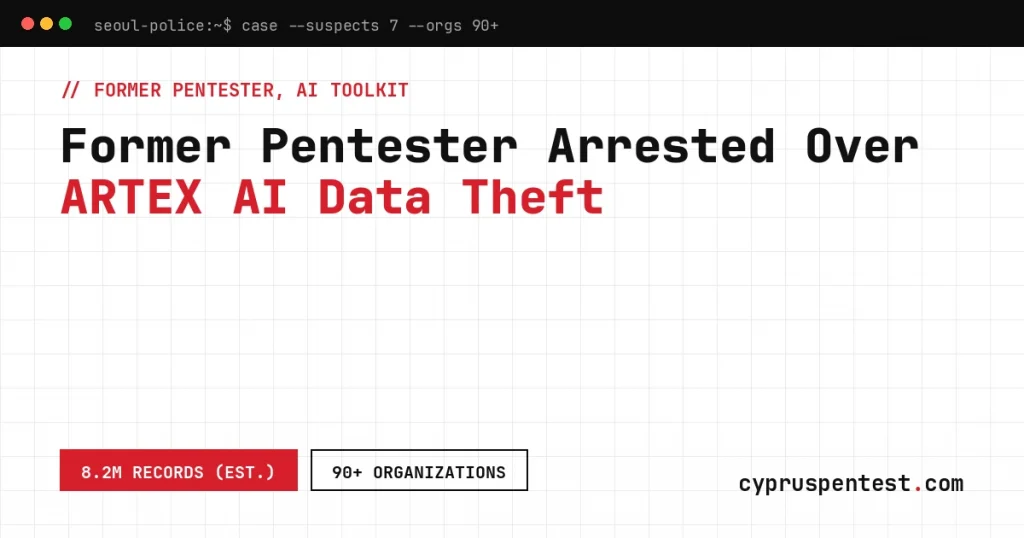
Seoul police have arrested a former penetration tester accused of leading a campaign that breached more than 90 South Korean organizations, using the ARTEX AI framework in most attacks and taking an estimated 8.2 million records.
Key takeaways
- Seven suspects are tied to more than 90 breaches and an estimated 8.2 million stolen records. ARTEX AI was used in most attacks.
- The leverage was leak threats, not encryption: 360 million won (about $270,000) demanded in 38 incidents.
- Only the alleged leader, a former pentester, remains in custody; he was referred to prosecutors on October 23, 2026.
- No access vector or indicators have been released; alert on bulk access, abnormal authentication and outsized outbound transfers.
What did Seoul police establish about the ARTEX AI data theft?
Seoul Metropolitan Police tied seven suspects to breaches of more than 90 organizations, most involving ARTEX AI, an autonomous penetration-testing framework. Police told Yonhap News it was South Korea’s first arrest in a large-scale hacking and personal-data theft case that exploited generative AI.
All seven were arrested, but only the alleged leader remains in custody. He was arrested on October 15, 2026, formally detained two days later and referred to prosecutors on October 23. The other six remain under investigation.
Yonhap describes him as a self-taught 32-year-old hacker, and local media report that he worked at a cybersecurity company from 2019 to 2022. Police say he began attacking in September 2025 with conventional tools and added AI utilities in late August 2026 to scale up.
A victim complaint in June started the case, and investigators traced the suspects through server logs from breached organizations. “Even individuals who are not professional hacker organizations can now hack on a large scale with the help of AI,” police told Yonhap.
Was it ransomware, and what did the extortion cost?
The reporting describes no encryption. The leverage was the threat to leak. Authorities believe the attackers took 8.2 million records from educational institutes, hospitals, large corporations and golf courses. In 38 incidents they demanded 360 million won (about $270,000) for not leaking data. The reporting does not say whether that sum was per incident or the total.
Police are still checking the dark web and have confirmed no listing. Paying buys a promise, not proof of deletion, so the incident stays open.
What should a Cyprus firm test after the ARTEX AI case?
Police have not released the vulnerabilities, indicators or initial-access vector, and nothing shows that ARTEX AI itself was the exploit. Tools like it typically automate work against familiar weaknesses: exposed services, reused credentials, unpatched software and flat networks.
Practitioner’s note: in authorized engagements, our automated tooling produces bursts of authenticated requests, rapid directory walks and bulk exports from a single identity. Few clients alert on any of these. Check that you would catch:
- abnormal authentication, new web shells, privilege changes and archive creation on servers holding personal data;
- outbound transfers far above each system’s baseline;
- edge, VPN, identity, WAF and database logs kept long enough, with synchronized clocks, to reconstruct a months-long intrusion;
- every pentest or AI agent tool in your estate, licensed or shadow-installed, with an owner and a defined scope.
Detection starts your reporting clock: 72 hours to notify the supervisory authority under GDPR, a 24-hour early warning for NIS2 entities, and for EMIs under DORA an initial notification within hours of classifying an incident as major.
Review former contractors’ accounts, shared API keys and dormant AI agents that still hold live keys. AI agent penetration testing shows what those identities can reach, and regular NIS2 penetration testing in Cyprus between annual cycles gives you evidence for a regulator who asks what you knew and when.
FAQ
What is ARTEX AI and how was it used in the South Korea hacks?
ARTEX AI is an autonomous penetration-testing framework that police say was used in most of the more than 90 breaches. No version, vendor, licensing detail or initial-access method has been reported.
Did police link the ARTEX AI case to the South Korean bank attacks?
No. The bank attacks, attributed to a Chinese-speaking actor, reportedly used the same framework, but the reporting does not show that the same people were involved.
Could an AI-assisted intruder pull your customer data without tripping an alert? Our assumed breach assessment starts from that foothold and measures what your team sees next.